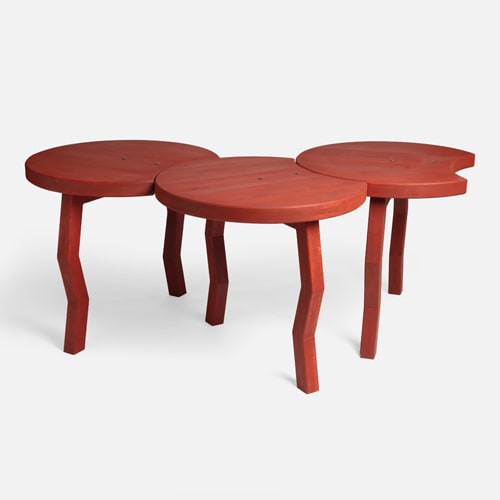
William Segerlind is a Swedish interior architect and furniture designer with a Bachelor's degree from Konstfack University of Arts, Crafts and Design. During his education, he expanded his perspective through an exchange program at Design Academy Eindhoven, and his work was recognized with support from the Josef Frank Scholarship Fund.
Segerlind’s practice focuses on interior architecture and furniture design, where storytelling acts as the foundation for both concept development and design. He is interested in how narratives can shape environments and objects, influencing everything from material choices and ornamentation to colour and spatial experience. His work is characterized by a playful and exploratory approach that seeks to challenge conventions while maintaining a strong commitment to sustainability.
With a background in woodworking and craft, Segerlind often works in the grey area between sculpture and furniture. Wood is his primary material, valued not only for its tactile and aesthetic qualities but also for its renewable character and strong connection to place. He works predominantly with Swedish timber, particularly pine, and frequently incorporates reclaimed materials into his projects. The natural properties of wood play an active role in shaping his designs, allowing material behaviour to inform form and construction.
Many of Segerlind’s projects are driven by broader social and cultural questions. His work Bredängsurnan explored cuts to cultural funding through the story of a notorious art thief, using ornamentation inspired by the historic Bergslagen Urn to reflect on the theft of shared cultural heritage. In his degree project, Död Ved (“Dead Wood”), he investigated adaptive reuse by comparing obsolete urban infrastructure to fallen trees in a forest ecosystem. Centered on the future closure of Enskede Gård metro station, the project proposed a community-run bazaar supported by five architectural objects inspired by the work of John Hejduk.
Whether designing furniture, objects, or interiors, Segerlind combines craftsmanship, narrative thinking, and material sensitivity to create meaningful experiences. His distinctive approach lies in his ability to tell stories through form, transforming social observations and cultural narratives into engaging physical realities.