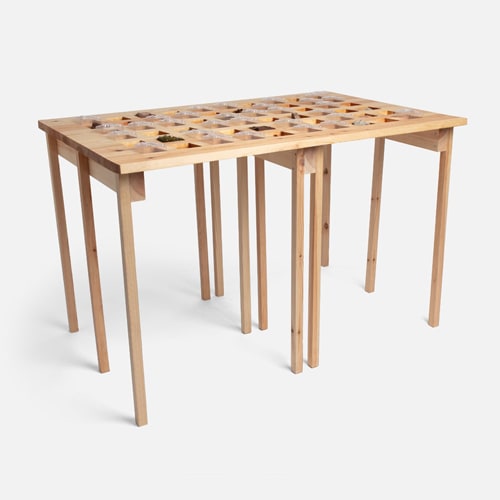
Shamik Khan is a designer and craft practitioner educated in the MFA Programme in Design at HDK-Valand, University of Gothenburg. Working across design research, strategic design, visual communication, and material-driven design, his practice investigates the relationships between materials, landscapes, and the social and ecological systems that shape them. Through a relational approach to design, he explores how materials can reveal hidden connections between people, places, labour, and more-than-human worlds.
His Master's degree project, Displaced Diasporas, examines how an awareness of material origins and what he describes as "material diasporas" can inform more situated and relational design practices. Combining material research, making, and critical reflection, the project creates space for dialogue around extraction, displacement, and the often-concealed origins of materials within global commodity systems. It proposes new ways of seeing, valuing, and engaging with landscapes in solidarity with land and ecological communities.
Alongside his thesis work, Shamik contributed to the development of Wieselgrensdagen, a community-led festival in central Hisingen, Gothenburg, providing strategic design consultancy and design support. He has also curated exhibitions featuring BIPOC artists and produced artist publications as part of his broader creative and research practice.
His work has been recognized through several scholarships and grants, including the Axel Adler Scholarship for Sustainability (2024), project grants from the Theodor and Hanne Mannheimer Foundation and Göteborgs Slöjdförening, a scholarship from Göteborgs Slöjdförening, and mobility funding from Nordic Culture Point.
Materials serve as the foundation of Shamik’s practice. Rather than treating them as passive resources, he approaches materials as active participants in the design process, allowing their histories, behaviours, and embedded relationships to inform both concept and form. He is particularly interested in working with wood, discarded limestone, and limestone dust from extraction processes, exploring how overlooked and waste materials can be recontextualized and given new significance.
Ecological and cultural questions are deeply embedded within his work. Through research, storytelling, and making, he investigates the environmental and social consequences of extraction while encouraging more responsible, situated, and empathetic approaches to material use. His design process combines ethnographic inquiry, observation, asset mapping, material exploration, prototyping, and iterative development, bringing together strategic thinking and hands-on craftsmanship.
What distinguishes Shamik’s practice is its commitment to tracing relationships. By critically examining the origins of materials and the systems that connect landscapes, people, and resources, he uses design as a tool for reflection, dialogue, and more sustainable ways of engaging with the world.