Henrique Bond Landaeta is a designer whose practice centres on the relationship between the body and the object—how people actually use things, rather than how they are expected to. Raised in a family of craftspeople, his work is grounded in a deep material awareness and a respect for making as both a practical and cultural process.
Before entering design, Bond Landaeta studied behavioural science with a Master in psychology and worked in research and assessment in Sweden. This background continues to inform his approach, shaping an understanding of human behaviour that translates into objects designed to support and enrich everyday life. He began his studies at Malmstens, Linköping University, in 2023 and was nominated for Ung Svensk Form in 2024.
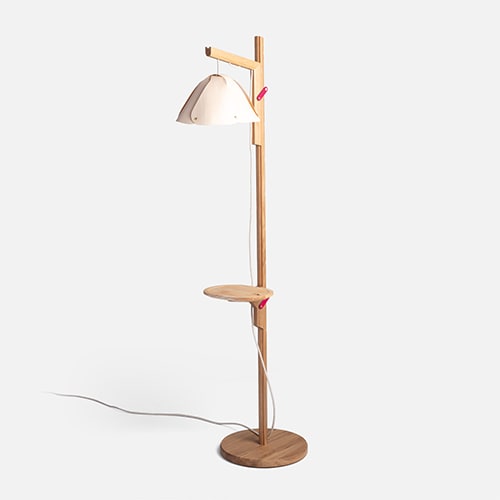
His degree project, NOD, is a floor lamp with an integrated surface for objects. The work explores adjustability as a constructive principle, enabling movement along a vertical axis to accommodate shifting needs and uses. Through this, NOD reflects a broader interest in adaptability—not only as a functional solution, but as a way of aligning design with the rhythms of daily life.
Bond Landaeta works primarily in wood, favouring Swedish and European species such as oak, beech, birch, and pine. Materials are selected based on their visual and tactile qualities, durability, and how they age over time. His approach follows the principle of placing the right material in the right context, always in dialogue with function and construction. Whenever possible, he sources materials locally and prioritises certified origins.
His process moves fluidly between analogue and digital methods. Ideas begin with ink on paper—the point at which thought first takes physical form—before developing through CAD and full-scale models. Form, function, and construction evolve simultaneously through an iterative process of testing and refinement rather than a fixed linear sequence.
Craftsmanship remains central to his practice, both as a method and a value. He emphasises the importance of details that reveal how something is made, and sees technical understanding as essential for meaningful collaboration with workshops and manufacturers. Across his work runs a consistent ambition: to create objects that are durable in material, construction, and expression, where function itself becomes a form of sustainability.
At its core, Bond Landaeta’s work is defined by a human-centred perspective—objects that balance aesthetics and use, while maintaining a clear connection to material, tradition, and the realities of everyday life.