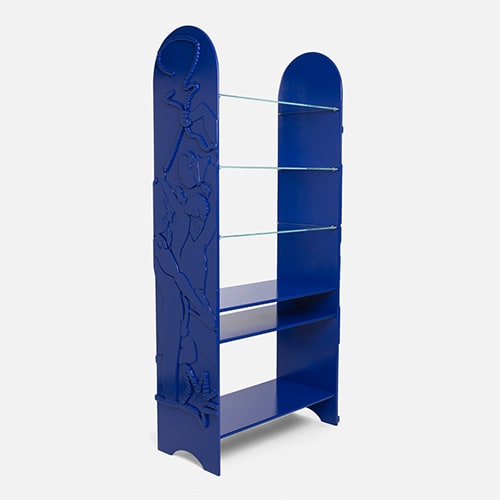
George Ganno is a designer whose practice is rooted in the conviction that designed objects are never neutral; they carry culture, history, and identity whether we intend them to or not. Working across furniture design, spatial installations, textile artefacts, and curatorial projects, his work investigates how objects and environments shape the ways we think, feel, and position ourselves in the world.
Ganno holds a Bachelor of Fine Arts in Design from HDK-Valand, University of Gothenburg (2026). His graduation project, Homeo (2026), was presented at the HDK-Valand graduation exhibition and awarded scholarships from both Slöjdföreningen and Estrid Ericson’s Foundation. The project resulted in the bookshelf Polari and the companion textile piece Show Me The Ropes. Anna Eklind, Head of the Design programme at HDK-Valand, describes his work as characterised by “an independent, artistic approach to design rooted in personal experience, producing strong expressions with touches of humor.”
At the core of Ganno’s practice is an ongoing investigation into the relationship between identity and space. He is particularly interested in how queer histories have historically been encoded into objects, environments, and visual languages out of necessity, and what happens when these codes are made explicit. In Polari (2026), a bookshelf made from birch and tempered glass, ornamental motifs reinterpret a forgotten 1960s gay coding system, translating subcultural language into furniture for the first time. The work challenges the assumption that design is neutral, instead proposing it as a medium for cultural memory and identity-making.
Material plays a central conceptual role in his work. Rather than accepting established material narratives, Ganno frequently works against them. In Polari, the use of birch—long associated with restraint and “honesty” in Scandinavian design—is deliberately subverted through a deep, high-gloss blue lacquer, aligning the material with queer decadence rather than Nordic functionalist ideals. Across his practice, materials are treated as cultural signifiers that can be challenged, transformed, and recontextualised.
Alongside concept-driven work, Ganno also engages with more sensory explorations in his tufted rugs, where texture, tactility, and colour become primary carriers of meaning. His spatial installation Between the Lines takes the form of a staged dining experience designed to provoke discussion around cognitive dissonance, demonstrating his interest in creating situations where design acts as a “conversation piece.”
Ganno’s process is interdisciplinary and non-linear, combining archival research, personal experience, drawing, and writing. Writing functions as a tool for conceptual development, while drawing—particularly his practice of hand-drawn figurative motifs—serves as a way of thinking through form. Craftsmanship remains central in his practice; even when using CNC milling, he preserves a clear sense of the maker’s presence by reintroducing manual finishing to retain gestural qualities.
Influenced by visually distinctive filmmakers such as Pedro Almodóvar, John Waters, and Derek Jarman, Ganno’s work embraces theatricality, colour, and queer sensibility. Across projects, he is drawn to design that begins with a question rather than a solution—where function emerges as a consequence of concept rather than its starting point.