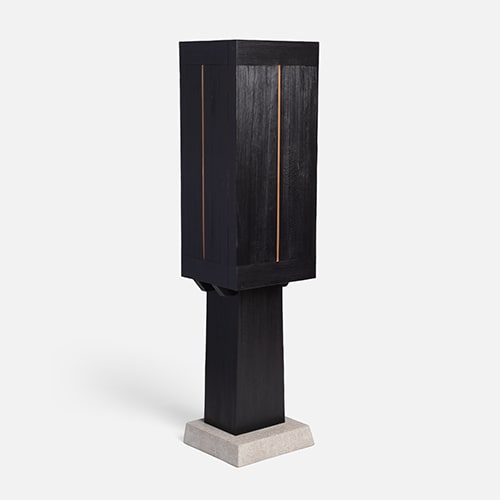
Fredrik Eliasson is a furniture maker educated at Malmstens, where he has developed a practice rooted in material sensitivity, craftsmanship, and a deep respect for tradition. His work centres on the relationship between surface, structure, and tactility, with a particular focus on how material treatment contributes to an object’s identity and presence.
During his studies, Eliasson completed the journeyman’s piece Styrsjöbo, designed together with Ebba Mathsson. The cabinet explores how surface can carry narrative, featuring a tactile topographic relief inspired by the landscape surrounding the village of Styrsjöbo in Dalarna. Executed in Swedish pine, the work reflects a commitment to local materials and sustainable making, while also challenging conventional hierarchies of what constitutes “fine” cabinetmaking materials. The project positions furniture as a medium for storytelling—connecting place, memory, and responsibility in material form.
His degree project investigates wood burning as an aesthetic surface treatment within furniture making, drawing on the Japanese technique yakisugi. Through systematic material testing and construction experiments, Eliasson examines how burning affects the form stability of panel constructions. The results demonstrate that while all constructions deform under heat, different structural strategies redistribute movement in distinct ways. These insights are ultimately translated into a built cabinet, where multiple construction principles are combined to manage material movement while maintaining precision.
Eliasson’s practice is strongly informed by an interest in materiality, surfaces, and tactility. For him, an object should engage the entire body—not only vision—and its character emerges as much from how material is treated as from its form or construction. His approach begins with close observation: understanding the inherent qualities of a material and allowing them to guide both design and making.
Working primarily with Swedish wood species, particularly pine, Eliasson emphasises the cultural and ecological value of local resources. By sourcing and processing materials himself—such as sawing his own veneer—he maintains control over the entire process while advocating for a more locally grounded production culture.
His design process is exploratory and dialogue-driven. Ideas can emerge from technical challenges, forms, or everyday observations, and are often developed through sketching, conversation, and hands-on experimentation. Craftsmanship plays a decisive role throughout, functioning not only as execution but as a method for thinking, testing, and refining ideas.
Eliasson was recently awarded a scholarship from Julfonden (Frimurarna), recognising his combination of creative ambition and entrepreneurial thinking. Together with designer Jonathan Ceder, he is building a collaborative practice that bridges craftsmanship, design, and industrial production, with the aim of establishing a sustainable and forward-looking furniture business.
Across his work, Eliasson seeks a balanced dialogue between past, present, and future—where tradition informs innovation, and material knowledge becomes the foundation for contemporary design.