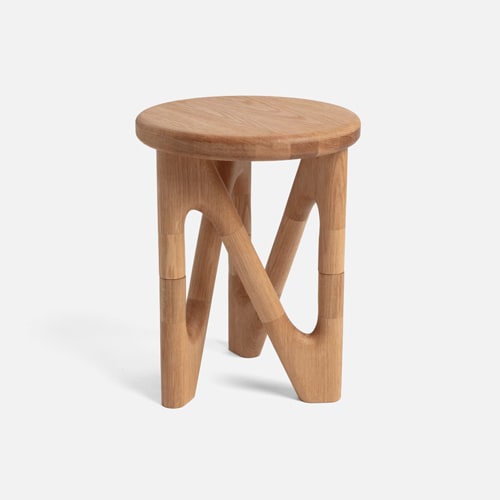
Ellen Morein is a designer educated at HDK-Valand whose practice focuses on furniture design, spatial installations, and modular systems. Through an exploration of form, adaptability, and user interaction, she develops designs that respond to changing needs while maintaining a strong sculptural presence.
Her degree project investigates how furniture can be both stable and adaptable through the development of a modular furniture system. Driven by an interest in form as well as functionality, the project resulted in a flexible system that can be reconfigured for different uses and situations. By combining visual expression with modular thinking, Ellen explores how furniture can evolve alongside its users and environments.
Nature is an important source of inspiration in her work. She is particularly drawn to patterns, structures, and forms found in natural systems, as well as the relationships that emerge through observation of everyday surroundings. These references often provide the foundation for new furniture and spatial design concepts.
Wood plays a central role in her practice due to its versatility and potential for transformation. Rather than emphasizing the traditional form of a plank, Ellen seeks to explore wood in unexpected ways, creating sculptural forms that reveal both simplicity and complexity. Materials inform her work through hands-on experimentation, allowing construction and form to develop together.
Her design process often begins through playful exploration with paper, using cutting, folding, and model making to investigate shapes and spatial relationships. Ideas are then refined through sketching, digital modelling, and prototyping, creating a dialogue between intuitive discovery and technical precision.
Functionality is essential to Ellen’s work, but form is frequently the starting point. She develops shapes that spark curiosity and then works to integrate usability, construction, and ergonomics. By combining CNC manufacturing with traditional hand-finishing techniques, she balances experimentation with craftsmanship and precision.
What distinguishes Ellen’s work is the interplay between playfulness and simplicity. Her approach combines intuitive form-finding with careful technical development, resulting in furniture and spatial structures that feel both expressive and accessible. As she describes it: she plays her way to the form and models her way to the function.