Ellen Jakobsson is a designer educated in Textile Art and Spatial Design at Konstfack. Her practice moves between craft, material exploration, and spatial design, with a particular interest in how knowledge develops through making. Rooted in a textile background, her work investigates the relationship between materials, tools, and embodied forms of learning that emerge through long-term engagement with craft.
Her Master's thesis project, Mellan Händer (Between Hands), grew out of the transition from textile craft into the field of spatial design and interior architecture. The project explored tacit knowledge and the role of making as a way of thinking in itself. Rather than treating craft as the execution of an idea, Ellen investigated how understanding is formed through materials, repetition, and hands-on practice, asking what happens when the hands know something before it can be fully expressed through words or drawings.
At the centre of the project was a collection of yellowed paper salvaged from old passepartouts and backing sheets from picture frames. Drawn to the unique traces of time embedded within the material, Ellen explored how knowledge from textile traditions could be transferred to an unfamiliar material. Through collecting, cutting, weaving, testing, and making, she investigated how discarded paper could acquire new value through techniques traditionally associated with textiles.
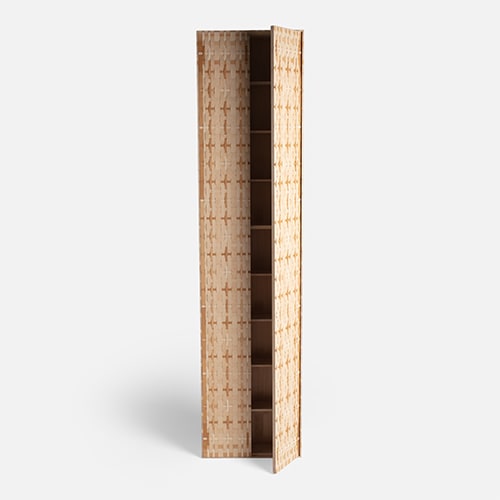
One outcome of this research was Verktygsskåp (Tool Cabinet), a birch cabinet with woven paper doors. Rather than beginning as a furniture design project, the cabinet emerged through a material-led process in which craft knowledge, experimentation, and material behaviour guided the development of form. The piece became both a physical object and an exploration of how knowledge travels between materials, disciplines, and contexts.
Material exploration remains central to Ellen’s practice. She is particularly interested in translation—how techniques, methods, and ways of thinking can move from one discipline to another and generate unexpected results. Influenced by ideas of material agency, she views materials as active participants in the design process rather than passive resources waiting to be shaped.
Working through experimentation rather than predetermined outcomes, Ellen allows form to emerge through making. Craftsmanship serves not only as a means of production but as a method for inquiry, reflection, and knowledge generation. Through her work, she examines how materials, tools, and processes contribute to the creation of meaning and understanding.