Andreas Lejon is a Master’s student at Konstfack whose practice spans furniture design, product development, and ecological transition. His work is grounded in a material-driven approach, where hands-on experimentation and prototyping allow materials to guide both concept and form. Rather than treating materials as passive elements, he engages with their origin, behavior, and limitations, using them as active agents in the design process.
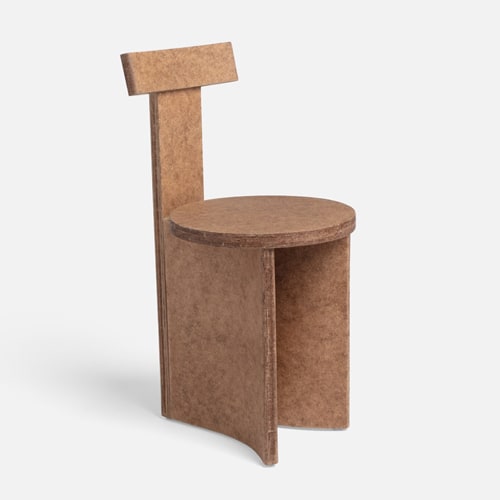
During his studies, he developed Annual Matter, a project exploring pinecones as a renewable resource that can be collected without felling trees. Through a series of material experiments involving heat, pressure, pine resin, and pinecone fractions, he investigated how this overlooked resource can be transformed into new applications for furniture and objects. The project resulted in a chair prototype, a lamp, a tray, and a collection of material samples that together propose an alternative approach to forest-based design. By working with an annually renewable material, the project questions traditional extraction methods and opens up discussions around timescales of growth and material use.
His work has been nominated for the Stavenow Scholarship and awarded the Jubelfondens Scholarship, with the chair selected for exhibition at Träart 2026 in Bodafors. Craft plays a central role in his process, particularly through testing and making as a way to understand material possibilities and constraints. Alongside this, he moves fluidly between analog and digital methods, refining form through iterative development.
Lejon’s practice is driven by an interest in how design can respond to the climate crisis through new material strategies and production methods. He works with local and “honest” materials, often focusing on wood, metal, and emerging composites, seeking ways for objects to align with both ecological and cultural contexts. His projects investigate how design can reduce pressure on natural resources while maintaining relevance within everyday life. Ultimately, his work positions design not only as problem-solving, but as a means of proposing new relationships between people, materials, and the environments they inhabit.